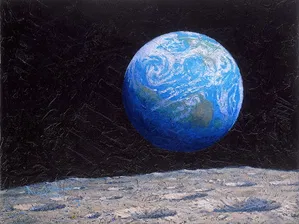
This Beautiful Planet is Revolving Around the Three of Us Giclee On Canvas by Alan Bean

This Beautiful Planet is Revolving Around the Three of Us by Alan Bean — Giclee On Canvas
5/5 Stars Votes Total: 1

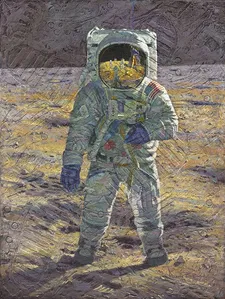
This Beautiful Planet is Revolving Around the Three of Us by Alan Bean is a giclee on canvas. Dimensions: Height11 inxWidth 16 in . Edition size: Limited Edition of 125. item# ABPLANETB

Offers Retail: $800.00 USD..  |  Your Cost: $680.00 USD..  |  You save $120.00 (15% OFF)

Layaway at Regular price: $800.00  |  Plan: 3 payments of $266.67 every 60 days  |  Questions? Call: 1-800-206-3715

Ends Friday, April 10, 2026  |  Availability There is currently 1 available of This Beautiful Planet is Revolving Around the Three of Us Giclee On Canvas at this price.

Available for purchase today, April  5, 2026 No Sales Tax Except In The State Of Florida. All products are shipped from our US Warehouses. For U.S. & Canadian Customers 🇺🇸 🇨🇦.


Get Your Cost for International Delivery
🇦🇺 🇦🇹 🇩🇰 🇫🇮 🇫🇷 🇩🇪 🇮🇪 🇮🇹 🇯🇵 🇳🇱 🇳🇴 🇪🇸 🇸🇪 🇨🇭 🇬🇧

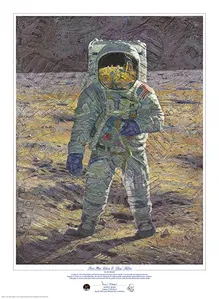
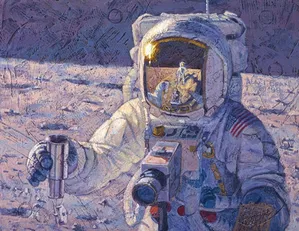
Alan Bean, a former Apollo 12 astronaut, transformed his firsthand experience of space exploration into stunning fine art paintings. As the only artist to have walked on the Moon, his work captures the textured surface of the lunar landscape, often embedding real moon dust and mission patches into his canvases. His impressionistic space paintings bring the Apollo era to life, showcasing astronaut moonwalks, celestial landscapes, and cosmic exploration from a perspective no other artist can provide. His limited edition space prints and original paintings remain highly sought after by collectors of space history art, making Alan Bean a pioneer in astronaut-inspired fine art.

This Beautiful Planet is Revolving Around the Three of Us � Giclee On Canvas - ABPLANETB

NOTES: This Beautiful Planet is Revolving Around the Three of Us � Giclee On Canvas - "This Beautiful Planet is Revolving Around the Three of Us" by Alan Bean The Apollo 16 crew have just awakened from their first sleep period. The previous day had been a busy and exciting one for John Young, Ken Mattingly, and Charlie Duke. It began with a flawless launch on top of the mighty Saturn V, a brief orbit around the Earth to check out their Command Module, and a long burn of the SIV-B third stage to reach translunar injection velocity. Once on their way toward the Moon, they separated from the spent rocket, turned around and docked with the lunar module, and then pulled it away for their 240,000 mile journey to the Moon. Because they are exposed to harsh continuous sunlight on their journey between the Earth and the Moon, they have oriented their docked spacecraft with the long axis perpendicular to the Sun. The crew then programmed their computer to slowly rotate their two spacecraft so that the temperatures within them remain within acceptable limits. Let's listen to CapCom Tony England's conversation with Lunar Module Pilot Charlie Duke, and Command Module Pilot Ken Mattingly: Charlie: Tony, you just went by my window, and that half Earth, man, is a spectacular sight. Tony: I bet it is. I'm green with envy. Charlie: Well, I don't want to trade with you. Tony: (With laughter) You say the world looked pretty good when it went by? Ken: How far out are we now, Tony? Tony: 108,285.1 (nautical miles) Ken: I think one of the most impressive sights, Tony, is the cloud formations you can see and the polar icecap. Because they are in the barbeque mode, John, Ken, and Charlie are seeing the Sun, Earth, Moon, and stars in a curious, yet strangely familiar way. It appears that the universe is revolving around them every seventeen minutes..

This Beautiful Planet is Revolving Around the Three of Us  Giclee On Canvas by Alan Bean 

Image Copyright © 2026 by Alan Bean
AUTHORIZED DEALER for Alan Bean

Alan Bean bio

Captain Alan Bean was the lunar module pilot on Apollo 12, the fourth man to walk on the moon and commander of Skylab 2. "I am fortunate enough to have seen sights no other artist ever has," Bean says. "I want my paintings to communicate an emotional experience in ways that photography cannot." Captain Bean creates his original works of art using a unique technique allowing the viewer to actually sense vestiges of the 20th century s most dramatic accomplishments. Pressed into the canvas surfaces are Captain Bean s authentic lunar boot "moonprints," impressions from a core tube-bit used to collect soil samples and marks from a hammer used to drive the staff of the American flag into the moon s surface. Moon dust, trapped on the patches on the outside of his suit, makes its way onto each original as well.

Each print and canvas is an historical record of the lunar experience, as each is signed by moonwalker Captain Alan Bean, with most countersigned by other moonwalkers and astronauts.This may be your only chance to own such a visionary and historic celebration of man s greatest achievement. NASA was sometimes asked "Why not send an artist to the moon?" It turns out they did.

Alan Bean—Apollo XII astronaut, commander of Skylab II and artist—was born in 1932 in Wheeler, Texas. In 1950 he was selected for an NROTC scholarship at the University of Texas at Austin. In 1955, he was commissioned an ensign in the United States Navy. Holder of eleven world records in space and astronautics, as well as numerous national and international honors, Alan Bean has had a most distinguished peacetime career. His awards include two NASA Distinguished Service Medals, the Yuri Gagarin Gold Medal and the Robert J. Collier Trophy. As part of the Apollo XII crew, he became the fourth of only twelve men ever to walk on the Moon. As the spacecraft commander of Skylab Mission II, he set a world record: 24,400,000 miles traveled during the 59-day flight. He has also launched himself successfully into a new career as an artist. When he wasn t flying, Bean always enjoyed painting as a hobby. Attending night classes at St. Mary s College in Maryland in 1962, Alan experimented with landscapes. During training and between missions as a test pilot and astronaut, he continued private art lessons. On space voyages, his artist s eye and talent enabled him to document impressions of the Moon and space to be preserved later on canvas. His art reflects the attention to detail of the aeronautical engineer, the respect for the unknown of the astronaut and the unabashed appreciation of a skilled painter. The space program has seen unprecedented achievements and Bean realized that most of those who participated actively in this adventure would be gone in forty years. He knew that if any credible artistic impressions were to remain for future generations, he must paint them now. "My decision to resign from NASA in 1981 was based on the fact that I am fortunate enough to have seen sights no other artist ever has," Bean said, "and I hope to communicate these experiences through art." Bean s book Apollo: An Eyewitness Account which chronicles his first-person experience as an Apollo astronaut in words and paintings was received with critical and popular acclaim upon its publication in 1998.